Vertical, Inc. was proud to host a roundtable on The Guin Saga in August 2008. Vertical’s Editorial Director Yani Mentzas, Genji Press proprietor Serdar Yegulalp, and Ninja Consultants Erin Finnegan and Noah Fulmor participated in the event and collectively edited the transcript that follows for clarity and continuity.
**WARNING**
**This transcript contains minor spoilers on the Guin Saga franchise.**
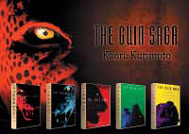
Yani: So today we come together to discuss The Guin Saga, which is a 120 volume and continuing epic fantasy series. Vertical has just finished publishing the first five books in translation: the “Marches Episode” of the saga. This was actually long in the coming. We started putting it out in hardcover in 2003; the first volume was actually one of the first four books we published, one of our debut works, along with Koji Suzuki’s Ring. We did three hardcover installments in the year 2003, but the sales weren’t good enough, so we had to stop.
We realized it was really a format issue, not a content issue. We originally went with $22.95 hardcovers. Also, regarding cover design, it didn’t really try to appeal to the manga-reading audience or the Japanophile audience. We realized our mistake and started reissuing the series in paperback in 2007, last year. Already, comparing the first three paperbacks with the three hardcovers—the hardcovers have been out for five years—the paperbacks have sold more.
We now have the $9.95 manga price point, but actually the books are even cheaper in Japan. Books are cheaper in Japan in general. Each volume of the saga only costs $5.00, plus it has a color spread, each volume. It is incredible. I don’t know how they do it. We tried to do this too, but it was cost-prohibitive.
Serdar: You actually beat me to this issue. I was actually going to bring a couple of those Japanese volumes in myself, and say, “Why can’t they be more like this?”
Yani: Right, right. 520 yen and they have a color insert. Of course, The Guin Saga is a bestseller, and if you’re selling more copies the unit cost goes down. But they didn’t know it was going to be a bestseller from the beginning, not from Book One, when they introduced the format—at least not such a massive bestseller. And so, we just have to conclude that Japanese publishers print at lower prices.
Erin: Yeah, I’ve been wondering for a long time if paper is cheaper in Japan...
Yani: Well the thing is a lot of these printers feel it to be an honor to be printing anything that is literary. They do want to make money. They make money from printing fliers. With books they are often willing to go at cost. It is a prestige job. Most printed material isn’t literary in any way. So, even if it is entertainment fiction, I think maybe they give much lower quotes.
Erin: My friends who have tried to publish their own comics here find the printing costs really prohibitive.
Serdar: That is always the most prohibitive part, although things like print on demand, which I’m using for my own project, have made it a lot easier without stumping for a huge initial outlay. It is still very difficult to get it under people’s noses in some form. But at least that part isn’t as difficult.
I was actually shopping in Book Off earlier today. I was looking specifically for Japanese-language Guin Saga volumes, so that I could talk about the form factor as one of the things that distinguishes the Japanese publishing model from the American publishing model. Here we have this size book for ten bucks. It has slightly rougher paper. This is something Vertical’s marketing manager was talking about before, which I thought was a great idea. I mean it really is pulp fiction. If we can do it in this size, what is there to stop us from doing it in that smaller size?
I realized if you tried to put it on a table in Barnes & Noble people would ignore it. They would think it was something someone else had left there, like a weekly or something. Like a Jack Chick tract!
Erin: Oh, because it’s so small?
Yani: It would get buried when it is that small. But this is the standard paperback size in Japan. There is one standard paperback size that all Japanese publishing companies use. That saves space for bookstores and at home too. Of course, that is not the case in the U.S. So if we tried to use the standard Japanese size it will just be overlooked.
Erin: In the American edition I noticed there were kind of wide margins and the line settings were far apart. It seemed they made the book appear much larger than it probably is, as if it’s double-spaced. But then again, it made me feel like I was reading really, really fast.
Serdar: That’s part of the idea. They market it to you like a foot to the floor kind of thing. Actually, I was going to ask how you wound up finding out about it and bringing it over here.
Yani: Well, I discovered it when I was in middle school. I was born and raised in Japan. I was a middle school student and had just discovered Tolkien a few years earlier. I was really getting into fantasy. Basically I was reading American fantasy. We had a lot of those in our school library: David Eddings, Lloyd Alexander, that kind of stuff. In fact, when I came to The Guin Saga, I was actually skeptical. I thought America and England, those are the places that produce the best fantasy series. So, I came to it a doubter. But by the end of Book Five, which is to say “The Marches Episode,” I was a total convert. When I turned eighteen, I came to the States. I had to put aside The Guin Saga because you couldn’t find the books over here. I think I’d read up to volume 35, 40 by then. That was 1990 when I came over.
Serdar: I am jealous already.
Page 1 | 2 | 3 | 4 | 5 | 6 | 7








 The original proposed
  An example of artist Naoyuki Katoh’s paintings, as found in the